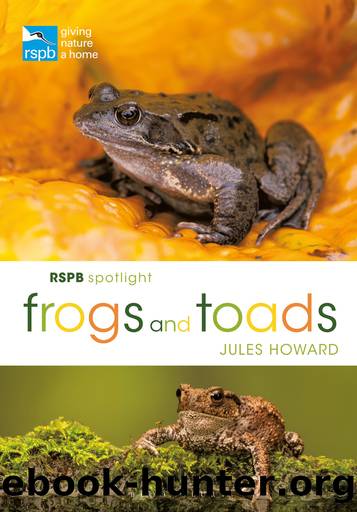
RSPB Spotlight Frogs and Toads by Jules Howard
Author:Jules Howard
Language: eng
Format: epub
ISBN: 9781472955821
Publisher: Bloomsbury Publishing
Published: 2019-06-15T00:00:00+00:00
Too much spawn? Amphibian populations naturally fluctuate because good times often bring with them ill fortune, disease and competition. This helps ensure populations don’t run riot.
Newts, including the (non-native) Alpine Newt (Ichthyosaura alpestris) are one of many known spawn-eating predators.
Spawn swapping
Spawn swapping was one of those idiosyncratic behaviours nature lovers once partook in, whereby those with too much spawn would donate it to schools and neighbours with ponds bereft of amphibian activity. My first memory of amphibians was just such an encounter, when a washing-up bowl of frogspawn was gifted to our school by a local villager. Sadly, such spawn swapping is no longer advisable, for a couple of reasons.
First, moving buckets of pond water around the country is a risky practice in itself, since it can accidentally transfer invasive species of aquatic plants from gardens into wild habitats. There, they often flourish, outcompeting native wildlife, proliferating and, in extreme cases, causing local flooding.
Second, there is a very real possibility that amphibian diseases (see here) can be spread by translocating spawn. At least one common disease of amphibians, an American ranavirus, has made it into the wild in the UK, probably through the pet trade. It is a disease that can be passed into new populations through the movement of infected spawn. For this reason in particular, moving spawn around is not a good idea. If you have a pond without spawn and you’re desperate for anuran visitors, hold your nerve if you can – in many cases, they will come. Common Frogs are quick to colonise new places for breeding, and even some very urban ponds can become haunts for the species if they are left alone for a year or two.
Download
This site does not store any files on its server. We only index and link to content provided by other sites. Please contact the content providers to delete copyright contents if any and email us, we'll remove relevant links or contents immediately.
Sapiens: A Brief History of Humankind by Yuval Noah Harari(14389)
The Tidewater Tales by John Barth(12659)
Mastermind: How to Think Like Sherlock Holmes by Maria Konnikova(7343)
The Thirst by Nesbo Jo(6944)
Do No Harm Stories of Life, Death and Brain Surgery by Henry Marsh(6941)
Why We Sleep: Unlocking the Power of Sleep and Dreams by Matthew Walker(6723)
Life 3.0: Being Human in the Age of Artificial Intelligence by Tegmark Max(5558)
Sapiens by Yuval Noah Harari(5370)
The Body: A Guide for Occupants by Bill Bryson(5096)
The Longevity Diet by Valter Longo(5064)
The Rules Do Not Apply by Ariel Levy(4969)
The Immortal Life of Henrietta Lacks by Rebecca Skloot(4587)
Animal Frequency by Melissa Alvarez(4470)
Why We Sleep by Matthew Walker(4445)
The Hacking of the American Mind by Robert H. Lustig(4381)
Yoga Anatomy by Kaminoff Leslie(4363)
All Creatures Great and Small by James Herriot(4321)
Double Down (Diary of a Wimpy Kid Book 11) by Jeff Kinney(4269)
Embedded Programming with Modern C++ Cookbook by Igor Viarheichyk(4179)
